Text
Ehon: The artist and the book in Japan
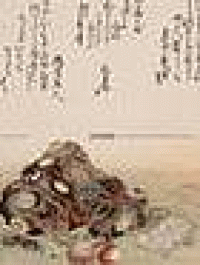
Ehon - or "picture books"- are part of an incomparable 1,200-year-old Japanese tradition. Created by artists and craftsmen, most ehon also feature essays, poems, or other texts written in beautiful, distinctive calligraphy. They are by nature collaborations: visual artists, calligraphers, writers, and designers join forces with papermakers, binders, block cutters, and printers. The books they create are strikingly beautiful, highly charged microcosms of deep feeling, sharp intensity, and extraordinary intelligence. In the elegant, richly illustrated Ehon: The Artist and the Book in Japan, renowned scholar Roger S. Keyes traces the history and evolution of these remarkable books through seventy key works, including many great rarities and unique masterpieces, from the Spencer Collection of the New York Public Library, one of the foremost collections of Japanese illustrated books in the West. The earliest ehon were made as religious offerings or talismans, but their great flowering began in the early modern period (1600-1868) and has continued, with new media and new styles and subjects, to the present. Shiohi no tsuto (Gifts of the Ebb Tide, 1789; often called The Shell Book) by Kitagawa Utamaro, one of the supreme achievements of the ehon tradition, is reproduced in full. Michimori (ca. 1604), a luxuriously produced libretto for a No play is also featured, as are Saito- Shu-ho's cheerful Kishi empu (Mr. Ginger's Book of Love, 1803), Kamisaka Sekka's brilliant Momoyogusa (Flowers of a Hundred Worlds, 1910), and many more. Ehon: The Artist and the Book in Japan ends with ehon by some of the most innovative practitioners of the twentieth century. Among these are Chizu (The Map, 1965), Kawada Kikuji's profound photographic requiem for Hiroshima; Yoko Tawada's and Stephan Kohler's affecting Ein Gedicht für ein Buch (A Poem for a Book, 1996); and Vija Celmins's and Eliot Weinberger's Hoshi (The Stars, 2005). The magnificent ehon tradition originated in Japan and developed there under very specific conditions, but it has long since burst its bounds, like any living tradition. Ehon: The Artist and the Book in Japan suggests that when artists meet readers in these contrived, protected, focused, sacred book "worlds," the possibilities for pleasure, insight, and inspiration are limitless. Ehon: The Artist and the Book in Japan was praised as "illuminating" in The New York Times' review of the New York Public Library's exhibit. http://travel2.nytimes.com/2006/10/21/arts/design/21ehon.html
Availability
Detail Information
- Series Title
-
-
- Call Number
-
741.6 Key e
- Publisher
- Seattle : University of Washington Press., 2006
- Collation
-
320p, ilus, 25 cm
- Language
-
Indonesia
- ISBN/ISSN
-
9780295986241
- Classification
-
741.6
- Content Type
-
-
- Media Type
-
-
- Carrier Type
-
-
- Edition
-
-
- Subject(s)
- Specific Detail Info
-
-
- Statement of Responsibility
-
-
Other version/related
No other version available
 Computer Science, Information & General Works
  Philosophy & Psychology
  Religion
  Social Sciences
  Language
  Pure Science
  Applied Sciences
  Art & Recreation
  Literature
  History & Geography