Text
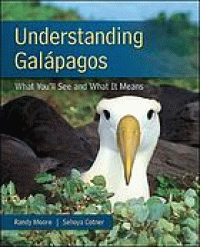
Understanding Galápagos : what you'll see and what it means
We wanted a book that includes up-to-date information about evolution in Galápagos, yet is accessible by professional biologists, laypeople, students, armchair travelers, and the merely curious. Naming the endemic-and often curious-organisms in Galápagos from checklists can be rewarding; that's why you will find checklists of the islands' iconic species in this book (Chapter 12). But understanding what you see is a different adventure, and that is one thing that we hope distinguishes this book from others. In short, we wanted to write a book that would help you not lust identify what you see, but understand what you see. Such an understanding goes beyond identification guides and traditional natural history and requires a context that includes the islands' biology, geology, climate, and history. In this book, you will find discussions (and checklists) of the native and endemic organisms you'll see, especially the iconic ones such as penguins, land and marine iguanas, finches, giant tortoises, and albatrosses (see color images). However, we have not described all of the organisms on the islands-after all, there are more than 600 species of lichens and 2,9OO species of marine organisms, not to mention the more than 50 families, 300 genera, and 370 species of endemic and native beetles. Similarly, we discuss many, but not all, of the most troublesome introduced species (at last count, there were more than 1,400 such species). We have focused on the native and endemic "stars" of Galápagos that fill tourists' must-see lists. Although our book emphasizes evolution, we have also addressed several other topics, for evolution cannot be understood without a corresponding understanding of its context: namely, the geology, climate, and historical impact of humans on the ecosystem. This is why you will find discussions of the islands' geology, weather, trails, and Visitor Sites in this book. We also wrote this book to emphasize the importance of preserving Galápagos, as well as to help readers understand the challenges facing the islands. To ensure accuracy and consistency, the information in this book was derived from visiting the islands more than 30 times over many years; talking with numerous Galápagos National Park Service guides, boat captains, boat crews, school teachers and other residents of Galápagos, and former prisoners at the Wall of Tears penal colony; documenting the GPS coordinates of more than 350 sites, usually with two independent GNPS units (Appendix 1); studying documents at a variety of libraries, research stations, and related locations such as GNPS, Charles Darwin Research Station, National Geospatial Intelligence Agency, and Instituto Oceanografico de la Armada; being on the bridge with boat captains in the most challenging conditions and regions of the islands (Appendix 2); and, when necessary, hiking, scuba diving, and interviewing local residents to resolve controversies (e.g., the exact location of Jessica; see Chapter 11).
Availability
Detail Information
- Series Title
-
-
- Call Number
-
508.8665 Moo u
- Publisher
- New York : Tata McGraw-Hill., 2014
- Collation
-
425 p. ; 24 cm.
- Language
-
- ISBN/ISSN
-
9780073532288
- Classification
-
508.8665
- Content Type
-
-
- Media Type
-
-
- Carrier Type
-
-
- Edition
-
-
- Subject(s)
- Specific Detail Info
-
-
- Statement of Responsibility
-
-
Other version/related
No other version available
 Computer Science, Information & General Works
  Philosophy & Psychology
  Religion
  Social Sciences
  Language
  Pure Science
  Applied Sciences
  Art & Recreation
  Literature
  History & Geography