Text
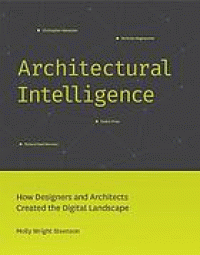
Architectural intelligence : how designers, tinkerers, and architects created the digital landscape
Architects who engaged with cybernetics, artificial intelligence, and other technologies poured the foundation for digital interactivity. In Architectural Intelligence, Molly Wright Steenson explores the work of four architects in the 1960s and 1970s who incorporated elements of interactivity into their work. Christopher Alexander, Richard Saul Wurman, Cedric Price, and Nicholas Negroponte and the MIT Architecture Machine Group all incorporated technologies—including cybernetics and artificial intelligence—into their work and influenced digital design practices from the late 1980s to the present day. Alexander, long before his famous 1977 book A Pattern Language, used computation and structure to visualize design problems; Wurman popularized the notion of “information architecture”; Price designed some of the first intelligent buildings; and Negroponte experimented with the ways people experience artificial intelligence, even at architectural scale. Steenson investigates how these architects pushed the boundaries of architecture—and how their technological experiments pushed the boundaries of technology. What did computational, cybernetic, and artificial intelligence researchers have to gain by engaging with architects and architectural problems? And what was this new space that emerged within these collaborations? At times, Steenson writes, the architects in this book characterized themselves as anti-architects and their work as anti-architecture. The projects Steenson examines mostly did not result in constructed buildings, but rather in design processes and tools, computer programs, interfaces, digital environments. Alexander, Wurman, Price, and Negroponte laid the foundation for many of our contemporary interactive practices, from information architecture to interaction design, from machine learning to smart cities.
Availability
Detail Information
- Series Title
-
-
- Call Number
-
720.105 Ste a
- Publisher
- Cambridge : The MIT Press., 2017
- Collation
-
312 p. ; 24 cm.
- Language
-
- ISBN/ISSN
-
9780262037068
- Classification
-
720.105
- Content Type
-
-
- Media Type
-
-
- Carrier Type
-
-
- Edition
-
-
- Subject(s)
- Specific Detail Info
-
-
- Statement of Responsibility
-
-
Other version/related
No other version available
 Computer Science, Information & General Works
  Philosophy & Psychology
  Religion
  Social Sciences
  Language
  Pure Science
  Applied Sciences
  Art & Recreation
  Literature
  History & Geography