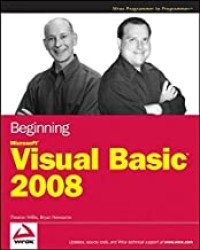
Text
Beginning Microsoft Visual Basic 2008
Beginning Microsoft Visual Basic 2008 is designed to teach you how to write useful programs in Visual Basic 2008 as quickly and easily as possible. There are two kinds of beginners for whom this book is ideal: You’re a beginner to programming and you’ve chosen Visual Basic 2008 as the place to start. That’s a great choice! Visual Basic 2008 is not only easy to learn, it’s also fun to use and very powerful. You can program in another language but you’re a beginner to .NET programming. Again, you’ve made a great choice! Whether you’ve come from Fortran or Visual Basic 6, you’ll find that this book quickly gets you up to speed on what you need to know to get the most from Visual Basic 2008. Visual Basic 2008 offers a great deal of functionality in both tools and language. No one book could ever cover Visual Basic 2008 in its entirety—you would need a library of books. What this book aims to do is to get you started as quickly and easily as possible. It shows you the roadmap, so to speak, of what there is and where to go. Once we’ve taught you the basics of creating working applications (creating the windows and controls, how your code should handle unexpected events, what object-oriented programming is, how to use it in your applications, and so on), we’ll show you some of the areas you might want to try your hand at next. To this end, the book is organized as follows: Chapters 1 through 9 provide an introduction to Visual Studio 2008 and Windows programming. Chapter 6 provides an introduction to XAML and Windows Presentation Foundation (WPF) programming. Chapter 10 provides an introduction to application debugging and error handling. Chapters 11 through 13 provide an introduction to object-oriented programming and building objects. Chapter 14 provides an introduction to creating Windows Forms user controls. Chapter 15 provides an introduction to graphics in Windows applications. Chapters 16 and 17 provide an introduction to programming with databases and covers Access, SQL Server, ADO.NET and LINQ. Chapters 18 and 19 provide an introduction to ASP.NET and show you how to write applications for the Web. Chapter 20 provides a brief introduction to XML, a powerful tool for integrating your applications—regardless of the language they were written in. Chapter 21 introduces you to web services and the Windows Communication Foundation (WCF). Chapter 22 introduces you to sequential workflows using the Windows Workflow Foundation (WF). Chapter 23 introduces you to building applications for mobile devices using the Compact Framework classes. Chapter 24 introduces you to deploying applications using ClickOnce technology. Chapter 25 provides some insight on where to go next in your journey to learn about VisualBasic 2008. Appendix A provides the answers to chapter exercises. Appendix B introduces the Microsoft Solution Framework. Appendix C provides some background on security. Appendix D provides insight into Windows CardSpace. Appendix E compares the differ
Availability
Detail Information
- Series Title
-
-
- Call Number
-
005.276 Wil b
- Publisher
- Canada : Wiley., 2008
- Collation
-
-
- Language
-
Indonesia
- ISBN/ISSN
-
9780470191347
- Classification
-
005.276
- Content Type
-
-
- Media Type
-
-
- Carrier Type
-
-
- Edition
-
-
- Subject(s)
- Specific Detail Info
-
-
- Statement of Responsibility
-
-
Other version/related
No other version available
 Computer Science, Information & General Works
  Philosophy & Psychology
  Religion
  Social Sciences
  Language
  Pure Science
  Applied Sciences
  Art & Recreation
  Literature
  History & Geography